
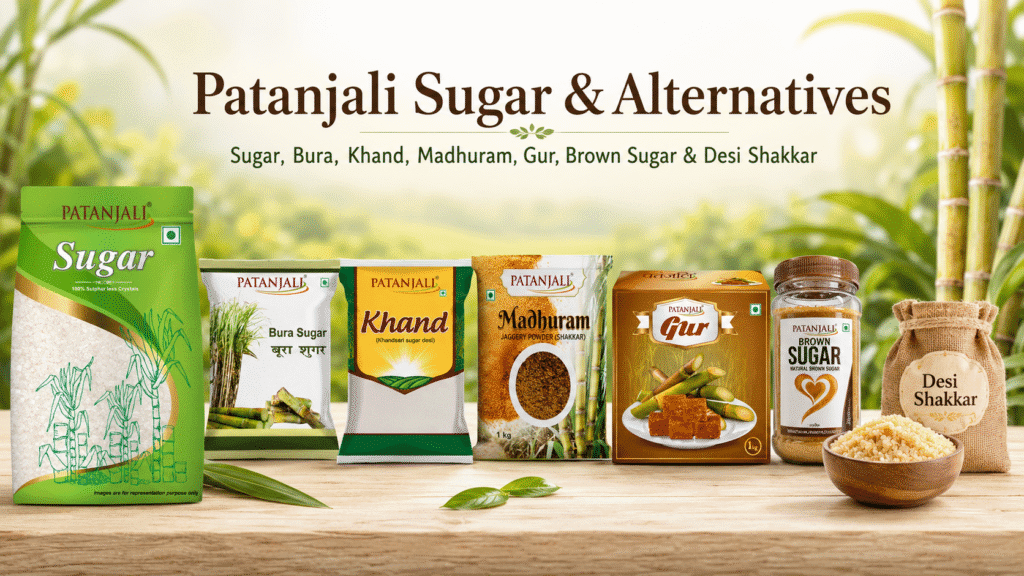
In Indian homes, sweetness is not limited to only white sugar. Many families use bura, khand, desi shakkar, gur, jaggery powder, brown sugar and normal sugar according to taste, tradition and recipe. Patanjali also offers different sugarcane-based sweeteners such as Sugar, Bura Sugar, Khand, Madhuram Sugar, Gur, Brown Sugar and Desi Shakkar.
Although all of them are used for sweetness, they are not exactly the same. Their difference comes from processing, texture, molasses content, colour, taste, Ayurvedic properties and mineral content.
Ayurvedic View: What Bhavaprakasha Says
In Ayurveda, sugarcane and its preparations are discussed under Ikshu Varga. Classical texts like Bhavaprakasha Nighantu explain that products made from sugarcane can have different properties depending on how they are prepared.
This is an important Ayurvedic concept:
Same source, different processing, different guna.
For example, Guda or jaggery is not considered exactly the same as Sharkara or sugar. Similarly, Khanda has its own identity. The modern product names used today may not always appear exactly in classical texts, so we understand them by their closest Ayurvedic category.
Ayurvedic Comparison of These Sweeteners
| Product | Closest Ayurvedic understanding | Rasa | Guna / Nature | Virya | General Ayurvedic view |
|---|---|---|---|---|---|
| Sugar / Cheeni | Sharkara / Sita | Madhura | Lighter than jaggery, cooling tendency | Sheeta | Useful where cooling sweetness is required; traditionally linked with pitta-daha pacifying use |
| Bura Sugar | Fine form of Sharkara | Madhura | Similar to sugar, mainly texture difference | Sheeta | Used like sugar, especially in sweets, lassi and traditional preparations |
| Khand / Desi Khand | Khanda / Khandsari | Madhura | Snigdha, nourishing, less refined than sugar | Sheeta | Considered more traditional than refined sugar; generally vata-pitta balancing in classical view |
| Gur / Jaggery | Guda | Madhura | Guru, snigdha, heavier | Ushna | Vata-reducing, but fresh jaggery may increase kapha and heaviness |
| Madhuram Jaggery Powder | Powdered Guda | Madhura | Similar to jaggery, but in powder form | Ushna | Used where jaggery taste and traditional sweetness are preferred |
| Desi Shakkar | Close to Guda / unrefined cane sweetener | Madhura | More traditional and less refined than white sugar | Closer to Guda category | Used as a traditional sweetener, but still sugarcane-based |
| Brown Sugar | Close to unrefined cane sugar / Khanda-type understanding | Madhura | Mild molasses taste, less refined character | Usually closer to cooling sugar category, depending on processing | Used for caramel-like taste and brown colour |
Fresh Jaggery and Old Jaggery in Ayurveda
Ayurveda also differentiates between new jaggery and old jaggery.
Fresh jaggery is generally considered heavier and more kapha-increasing. It may not suit everyone, especially people with kapha tendency, weak digestion, heaviness, cough tendency or excess mucus.
Old jaggery is traditionally considered better than fresh jaggery. It is regarded as more pathya, better for digestion and more suitable in some classical uses.
So from an Ayurvedic view, Gur is not simply “better sugar.” Its effect depends on age, quantity, digestion, season and patient condition.
How These Products Are Prepared
All these products mostly come from sugarcane, but their preparation changes their final quality.
| Product | Brief preparation process |
|---|---|
| Sugar / Cheeni | Sugarcane juice is extracted, clarified, concentrated, crystallised, centrifuged, dried and packed. Most molasses is removed. |
| Bura Sugar | Sugar is converted into a fine, powdery or soft grain form. The main difference is texture. |
| Khand | Sugarcane juice is boiled and concentrated, traditionally by open-pan process. It is less refined and may retain some molasses character. |
| Gur / Jaggery | Sugarcane juice is boiled, concentrated and set into blocks or lumps. It retains more natural cane flavour and molasses. |
| Madhuram Jaggery Powder | Similar to jaggery, but instead of block form it is dried and powdered for easier use. |
| Desi Shakkar | A traditional granular or powdered cane sweetener, closer to jaggery-type preparation than refined sugar. |
| Brown Sugar | Cane sugar with brown colour and molasses-like flavour. It is used where caramel-like taste is preferred. |
Calories: Are They Very Different?
From a calorie point of view, the difference is very small. Almost all of them give around 3.8 to 4 calories per gram.
| Product | Approximate calorie value |
|---|---|
| Sugar / Cheeni | 3.8–4.0 kcal per gram |
| Bura Sugar | 3.8–4.0 kcal per gram |
| Khand | 3.8–4.0 kcal per gram |
| Brown Sugar | 3.8–3.9 kcal per gram |
| Gur / Jaggery | 3.8–3.9 kcal per gram |
| Madhuram Jaggery Powder | 3.8–3.9 kcal per gram |
| Desi Shakkar | 3.8–3.9 kcal per gram |
This means that if someone replaces one spoon of Sugar with one spoon of Gur, Khand or Desi Shakkar, the calorie difference is not very meaningful.
Nutrients and Minerals Present
The darker and less refined products may contain some minerals because they retain more molasses or natural cane components. However, these minerals are present in small quantities when we consider normal daily use.
Based on visible Patanjali product label information and product descriptions:
| Product | Minerals / nutrients shown or expected from label |
|---|---|
| Sugar / Cheeni | Mainly carbohydrate. No meaningful mineral value declared. |
| Bura Sugar | Mainly carbohydrate. No meaningful mineral value declared. |
| Khand | Small amount of sodium shown on visible label. |
| Brown Sugar | Small amount of sodium shown on visible label. |
| Madhuram Jaggery Powder | Calcium, iron, magnesium and sodium are shown in product information. |
| Desi Shakkar | Potassium, iron and sodium are shown in product information. |
| Gur / Jaggery | Traditionally contains small amounts of minerals due to less refinement, but exact value depends on product label. |
Among these, Desi Shakkar and Madhuram show the clearest mineral presence. Desi Shakkar has potassium and iron listed, while Madhuram Jaggery Powder shows minerals like calcium, iron and magnesium.
But it is important to understand:
Having some minerals does not make these products a health supplement. They are still mainly sweeteners.
Which One Should Be Used for What?
| Use | Suitable option |
|---|---|
| Daily tea or coffee where neutral taste is needed | Sugar or Khand |
| Traditional sweets like laddoo, peda, kheer | Bura Sugar, Khand or Desi Shakkar |
| Jaggery taste in sweets or beverages | Gur or Madhuram Sugar |
| Baking, caramel taste, cakes or cookies | Brown Sugar |
| More traditional less-refined sweetness | Khand, Desi Shakkar or Gur |
| Fine mixing in lassi, sharbat and mithai | Bura Sugar |
Important Note for Diabetic Patients
This is the most important point.
Gur, Madhuram, Desi Shakkar, Khand, Brown Sugar and Bura cannot be used as a replacement for sugar in diabetic patients. They may have different Ayurvedic properties like rasa, guna, virya and vipaka, and some of them may contain small amounts of minerals, but in terms of calories and blood sugar rise, they are broadly similar to sugar.
For a diabetic patient, the key issue is not only whether the sweetener is refined or unrefined. The key issue is that all these are sugarcane-based caloric sweeteners and can increase blood glucose.
So the correct advice is:
Use them according to taste, recipe, digestion and Ayurvedic suitability, but do not consider them diabetic-safe.
Final Summary
All these sweeteners come mainly from sugarcane, but their processing makes them different.
Sugar is refined and neutral.
Bura Sugar is fine sugar for sweets.
Khand is a traditional less-refined cane sugar.
Gur is concentrated sugarcane juice in block form.
Madhuram Sugar is jaggery powder.
Desi Shakkar is a traditional granular sweetener.
Brown Sugar has molasses-like colour and taste.
Ayurveda looks at them through qualities like rasa, guna, virya and effect on dosha, while modern nutrition looks at calories, carbohydrates and minerals. Both views are useful, but they should be understood correctly.
The best approach is simple:
Choose the sweetener according to purpose, taste and suitability, but use all of them in limited quantity.